





The problem is not just ‘increasing dispute volume’
Global payment cards in circulation (including credit, debit, and prepaid) are projected to reach approximately 31.44 billion by the end of 2026, according to tracking data from the Nilson Report. But as digital transactions grow, disputes are rising even faster. Mastercard estimates that number of global chargebacks will exceed 300 million annually in the next few years. At the same time, the nature of disputes is shifting. A significant portion now comes from ‘friendly fraud,’ where legitimate transactions are contested. Disputes are getting complex and regulators are tightening requirements around dispute timelines, evidence standards, and consumer protection, leaving little room for error. Missed deadlines or incomplete submissions directly translate into financial losses and compliance risk.
Why current dispute operations still struggle to scale
Most dispute platforms today already incorporate workflow automation, rule engines, and point AI capabilities. While these have improved efficiency, the gains have largely been incremental.
At their core, dispute operations remain fragmented. Handling a single case often requires navigating multiple systems for transactions, evidence, and case management while relying on static rules that struggle to adapt to context. Critical decision points still depend on manual intervention, and tools for fraud detection, dispute processing, and representment operate in isolation.
This creates an operating model that is automated in parts but not coordinated end to end. The impact is visible: backlogs persist despite automation; resolution times remain inconsistent; decision quality varies across teams; costs continue to rise with volume. Industry estimates from the Merchant Risk Council place the cost of a single chargeback at $50–$200, including fees, labor, and lost goods.
From automation to AI orchestration: the next shift
The next phase of dispute management is not about adding more tools, but about connecting intelligence across the lifecycle. This is where agentic AI orchestration changes the model. Instead of isolated workflows, AI agents operate as a coordinated layer that works across systems, shares context across every step of the dispute lifecycle, drives decisions and continuously improves based on outcomes. This shifts dispute management from a sequence of handoffs to a connected, decision-led system.
How this works in practice
With an orchestrated, AI-led approach, the dispute lifecycle becomes significantly more streamlined. Disputes are triaged instantly using transaction data, customer inputs, and behavioral signals to determine type, risk, and priority. Evidence is assembled automatically by pulling relevant data from payment systems, order platforms, and customer interactions into a structured case file. Decisions are guided by data, with AI assessing whether to accept or contest disputes based on historical success rates and transaction attributes. Responses are generated and submitted consistently, aligned to card network requirements and timelines, reducing errors and missed deadlines. Over time, the system learns continuously, improving accuracy and outcomes with each case.
Business impact: where value is realized
This shift translates into clear, measurable business outcomes:
- Lower operating costs through reduced manual effort and fewer rework cycles.
- Faster resolution times, helping eliminate backlogs and meet SLAs consistently.
- Higher win rates driven by stronger, more consistent evidence and better case selection.
- Improved compliance with evolving network requirements
The benefits extend across the ecosystem:
- For issuers: faster, more accurate decisioning reduces fraud losses, minimizes write-offs, and improves customer experience.
- For acquirers and merchants: better evidence and prioritization improve recovery rates and reduce revenue leakage.
More importantly, this approach enables true scalability. Dispute volumes can grow without a proportional increase in cost or headcount while maintaining consistency, control, and performance.
Moving upstream: from resolution to prevention
The biggest opportunity lies before disputes are even created. AI models can identify transactions likely to result in disputes by analyzing a combination of signals such as:
- Transaction patterns and anomalies
- Customer behavior and past dispute history
- Merchant characteristics (refund patterns, delivery delays, unclear descriptors)
- Payment context such as device, location, and authentication data
But prediction only matters if something acts on it. This is where collaboration networks like Mastercard’s Ethoca and Visa’s Verifi come in. They share dispute and transaction data in near real time surfacing confirmed fraud or refund requests. AI agent can consume an Ethoca alert or a Verifi inquiry, weigh it against the risk signals above, and take decisions.
How Opus supports this shift
Opus’ Intelligent Dispute Management platform is built around the principle of agentic orchestration. Rather than adding another layer of automation, it creates a unified operating model that connects data and workflows across the dispute lifecycle and orchestrates below specialized AI agents.
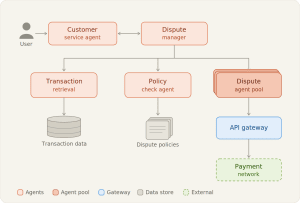
Below are indicative agents from dispute agent pool
| Agent | Description |
|---|---|
| Dispute Intake & Classification Agent | Interprets incoming disputes, classifies reason codes, and prioritizes cases based on risk and urgency. |
| Evidence Aggregation Agent | Collects and structures data from transaction systems, order platforms, and customer interactions into a complete case file. |
| Decisioning & Prioritization Agent | Evaluates whether to accept or contest disputes using historical outcomes, transaction attributes, and success probability. |
| Representment & Documentation Agent | Generates network-compliant responses and ensures timely, accurate submission of cases. |
| Compliance & SLA Monitoring Agent | Tracks deadlines and ensures adherence to evolving regulatory and network rules. |
| Learning & Insights Agent | Continuously improves decisioning by learning from outcomes and identifying dispute trends and root causes. |
Opus has transformed dispute operations for a mid-sized acquirer by deploying AI agents across intake, evidence, decisioning, and representment on the Opus AI platform. This enabled automated evidence aggregation, smarter case prioritization, and consistent, scheme-compliant submissions. The result was 30–50% faster resolution and up to 60% reduction in manual workload, along with improved representment outcomes. Merchant satisfaction increased while compliance risks reduced through better SLA adherence and standardized decisioning.
What’s next
Chargebacks have long been treated as an unavoidable cost of doing business. That assumption is starting to change with AI-led orchestration. Dispute management is moving from a fragmented, reactive process to a connected, decision-driven capability. But the real shift goes beyond efficiency. It is about control and predictability.
Organizations can move from:
- Reacting to disputes → to anticipating and preventing them
- Managing backlogs → to operating in real time
- Relying on manual judgment → to consistent, data-driven decisions
This also changes how dispute operations are measured. Instead of focusing only on resolution, leading institutions are now tracking Dispute avoidance rates, Cost per dispute trend.
The real opportunity is not just automating disputes, but it is turning dispute management into a strategic control function– one that protects revenue, improves customer trust, and scales with the business.
References
- Mastercard. (2025). State of Chargebacks Report.
- Merchant Risk Council. Estimated cost per chargeback: $150–$200.
- Verifi / Visa. Data on friendly fraud as a share of disputes.
- Reuters. Analysis of global payment fraud trends and AI interplay in 2024.
- Association for Financial Professionals. 2026 Payments Fraud and Control Survey.


