








November 25, 2026


In my previous blog, I explored how BNPL is changing the way consumers purchase products, manage payments, and interact with financial services.
But the BNPL story does not end with splitting a purchase into smaller instalments. A more interesting transformation is taking place: payments are evolving from a simple transaction mechanism into an intelligent, flexible and embedded financial experience.
Companies such as Affirm, Klarna and Splitit are playing an important role in this transformation. Although they share a common objective, which is to give consumers greater flexibility in how they pay, their business models and approaches reveal different ways in which the future of payments is taking shape.
Let’s explore what makes these players interesting and what their evolution means for the broader payments industry.
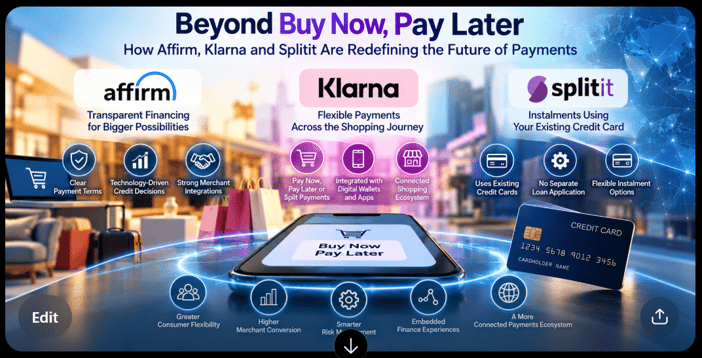
The Evolution of BNPL: From Payment Option to Financial Experience
Traditionally, consumers had a relatively straightforward choice at checkout: pay immediately using cash, a debit card or a credit card.
BNPL introduced another option, to purchase today and pay overtime through a predefined instalment plan.
However, the next phase is much more ambitious.
BNPL providers are increasingly integrating their services into merchant checkouts, digital wallets, mobile applications and everyday shopping journeys. Payment flexibility is becoming part of the customer experience rather than a separate financial product.
This creates value for multiple stakeholders:
- Consumers: Greater flexibility and predictable repayment schedules.
- Merchants: An additional payment option that may improve conversion and average order value.
- Fintech companies: Opportunities to combine payments, credit assessment, merchant services and digital engagement.
- Banks and payment networks: New partnership opportunities, alongside increased competition in the consumer credit space.
The real differentiator is no longer simply whether a customer can pay in instalments. It is how seamlessly, responsibly, and intelligently that option can be delivered.
Affirm: Bringing Transparency and Technology to Consumer Credit
Affirm has built its proposition around transparent, fixed-payment financing.
Rather than relying exclusively on traditional revolving credit, Affirm offers eligible consumers different ways to pay overtime, including short-term instalments and longer-term financing options.
Its approach has several important dimensions.
Transparent repayment structures
Consumers can review the repayment terms before committing to a purchase. Depending on the product and eligibility, financing may be interest-free or interest-bearing. Affirm also states that it does not charge late fees.
This emphasis on clear repayment terms is an important contrast to credit products where balances and interest can accumulate over time.
Technology-driven credit decisions
Credit assessment is central to the BNPL model. Providers need to evaluate the likelihood of repayment while keeping the checkout experience quick and convenient.
Affirm combines technology, underwriting and risk management to support financing decisions and tailor available payment options.
Integration into the shopping journey
Affirm works with merchants and payment platforms to make financing available at checkout, helping businesses present payment flexibility at the point where consumers make purchase decisions.
The broader lesson is that consumer financing is becoming increasingly integrated with payment processing and digital commerce.
Affirm's model demonstrates how transparency, risk management and merchant integration can work together to create a differentiated payment experience.
Klarna: Connecting Payments, Shopping and Digital Engagement
Klarna represents another evolution of the BNPL model: combining flexible payments with a broader digital shopping experience.
Its offering includes different payment choices, depending on the market and customer eligibility, such as paying immediately, paying later or splitting a purchase into instalments.
What makes Klarna particularly interesting is its emphasis on making these choices available across multiple shopping environments.
Flexible payments across channels
Klarna has expanded beyond conventional online checkout experiences through integrations with digital wallets, mobile applications and in-store payment journeys in supported markets.
For example, its partnerships involving Apple Pay and Google Pay illustrate how instalment options can be incorporated into payment experiences consumers already use.
A broader commerce ecosystem
The opportunity extends beyond processing payments. Shopping discovery, merchant offers, customer engagement and payment flexibility can be connected within a single digital journey.
This gives Klarna opportunities to build stronger relationships with both consumers and merchants.
Embedded and AI-enabled commerce
As shopping increasingly moves into conversational interfaces and AI-assisted experiences, payment providers have an opportunity to make financing available directly within those journeys.
Klarna's announced integration plans involving Google Search, the Gemini app and Google Pay illustrate this direction.
The key insight is that the future of payments may not always begin at a traditional checkout page. It may begin wherever a consumer discovers a product, compares options or decides to make a purchase.
Splitit: Rethinking Instalments Through Existing Credit Cards
Splitit offers a different approach.
Instead of primarily introducing a new credit product, Splitit enables participating merchants to offer instalment plans using a customer's existing eligible credit card.
This distinction is important.
Using existing credit infrastructure
When a consumer selects Splitit, the card issuer is asked to authorise the transaction. The first instalment is charged, while the remaining amount may be subject to a temporary authorisation hold, depending on the plan.
The customer continues to make scheduled instalment payments, subject to the terms of the particular arrangement.
Reducing the need for a separate loan application
Because the model uses an existing credit card, it can offer a different customer experience from BNPL products that involve a separate credit application or loan.
However, the customer needs sufficient available credit, and temporary authorisation holds can reduce the credit available for other purchases.
An interesting proposition for merchants
Splitit demonstrates that innovation in payments does not always require building an entirely new credit product. It can also come from using existing payment infrastructure in a different way.
For merchants and payment providers, this raises an important question: can better payment experiences be created by combining the capabilities consumers already have with more flexible transaction flows?
Three Companies, Three Different Approaches
Although Affirm, Klarna and Splitit operate in the broader instalment-payments ecosystem, their approaches are not identical.
Affirm - Financing-led innovation
Focuses on transparent pay-over-time products, technology-driven underwriting and integration with merchants.
Klarna - Commerce-led innovation
Connects flexible payments with shopping experiences, digital engagement and distribution through multiple channels.
Splitit - Card-infrastructure-led innovation
Uses existing credit-card infrastructure to facilitate instalment payments without necessarily requiring a separate loan product.
Together, these approaches demonstrate that BNPL is not a single, standardised business model. It is an evolving collection of payment and financing propositions.
The most suitable model depends on the consumer, merchant, transaction value, existing credit availability, local regulations and economics of the transaction.
What Makes These Models Work Behind the Scenes?
From a payments and technology perspective, the customer experience is only the visible part of the system.
Delivering a reliable BNPL service requires several capabilities working together.
Payment processing and orchestration
The system must manage payment authorisation, transaction status, instalment schedules, payment collection, refunds, cancellations and reconciliation.
These flows need to remain consistent across merchants, payment gateways, card networks and financial institutions.
Real-time risk assessment
Providers need to evaluate customer eligibility and repayment risk while minimising unnecessary friction at checkout.
This creates opportunities for data-driven underwriting, machine learning, fraud detection and continuous risk monitoring.
Reliable integrations and APIs
Merchants expect BNPL services to integrate with their existing e-commerce platforms, payment gateways and order-management systems.
API reliability, idempotency, error handling, transaction traceability and consistent status management are essential to avoid duplicate payments, inconsistent orders and reconciliation problems.
Scalable architecture
As transaction volumes grow, payment platforms must handle traffic spikes, maintain low latency and recover gracefully from failures.
Event-driven processing, resilient services, secure API integrations and effective monitoring can help support these requirements.
Data, security and compliance
Providers must protect sensitive information, manage access, detect suspicious activity and meet applicable lending, payments and consumer-protection requirements.
The challenge is to deliver a frictionless customer experience without compromising security, operational control or responsible lending.
This is where the intersection of payments expertise, modern software architecture, analytics and risk management becomes especially important.