






July 14, 2025


Recommended Blogs




Explore how blockchain enhances card tokenization by enabling secure, auditable, and decentralized digital payments for a trustless financial future.
65% of FIs worldwide reported ransomware attacks in 2024 with the average ransom demand reported at $4.2 million.
Do you still view compliance as a checkbox? In the evolving digital commerce landscape, securing cardholder data has moved far beyond being a compliance checkbox. It’s now foundational to customer trust and business continuity. While traditional card tokenization has served as a key defense mechanism, it is time for the next in payments. Growing transaction volumes and increasingly sophisticated threats to the financial ecosystem expose the limitations of centralized token vaults, posing a significant security challenge for fintech developers and stakeholders.
Tokenized cash and smart contracts automate transactions based on predefined conditions, ensuring security, transparency and efficiency.
~ World Economic Forum
Take a deep dive into Payment Tokenization in this blog.
However, at the core of this challenge lies an opportunity: combining the principles of blockchain with the mechanics of tokenization to build a more secure, auditable, and scalable future for card-based payments.
Card Tokenization Today
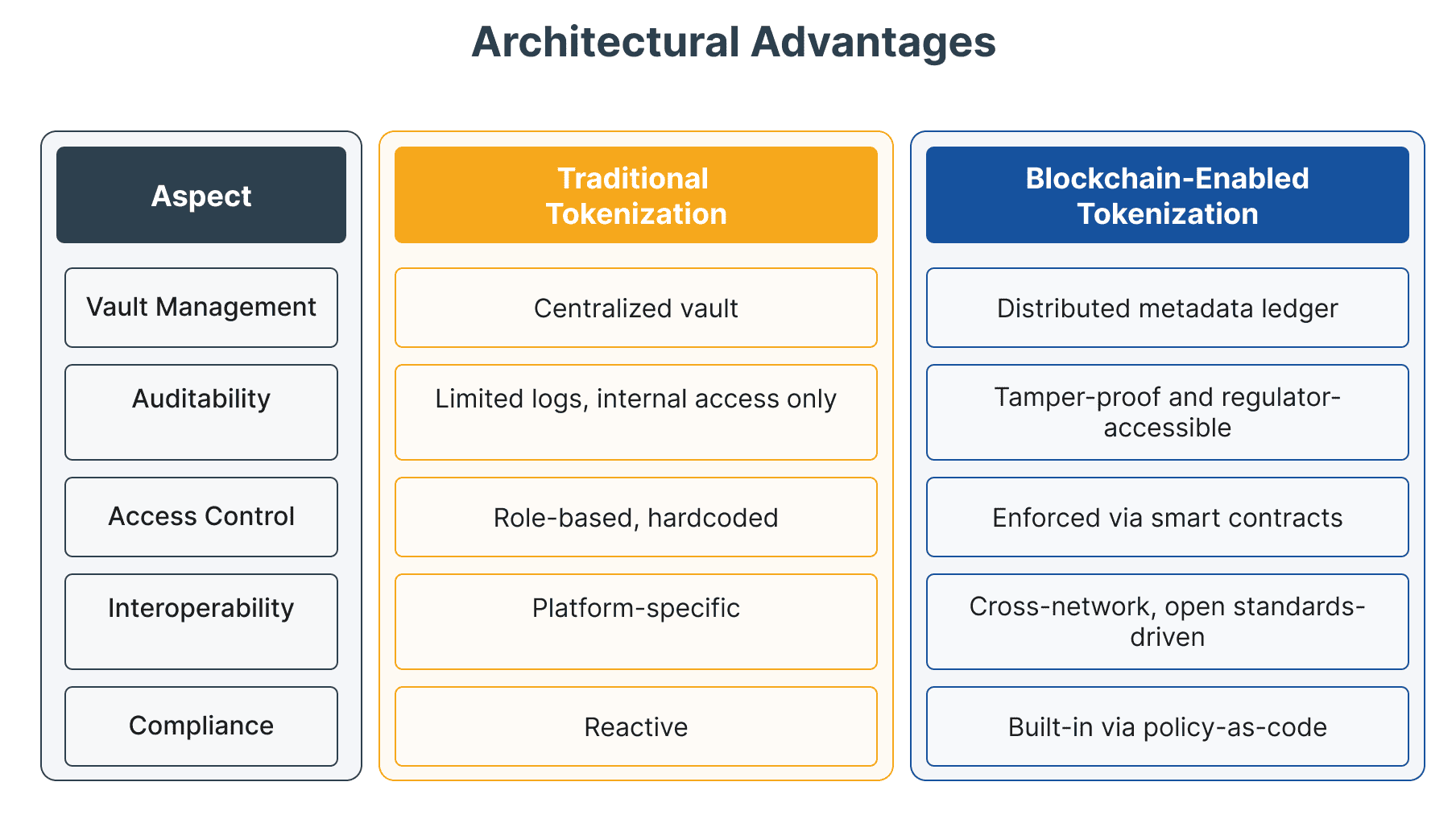
Traditionally, card tokenization substituted the Primary Account Number (PAN) with a non-sensitive and unique token. The original card number is stored securely, typically in a central vault managed by a payment network, issuer, or PCI DSS-compliant vault provider. Isn’t this how we have been managing payments long enough to recognize that this carries inevitable architectural trade-offs?
- Centralization risks: Single point failure, i.e., one breach can compromise the entire token mapping system.
- Limited visibility: Token usage logs are often siloed within proprietary systems.
- Scalability bottlenecks: Cross-entity integrations become complex, especially across borders or networks.
It’s like storing all your valuables in one locker with a key, which any seasoned infiltrator can duplicate. Technically, this approach lacks craftiness. Let me pull out a page from Voldemort’s book here. I know we aren’t supposed to take his name, but the guy split his soul into multiple fragments and hid them in horcruxes! Effectively, he prevented a single point of failure. Now, we cannot hide data or information in the interconnected payments space. However, the next generation of payments demands a distributed trust model. With Open Banking and open finance shaping the future of payments, a decentralized and transparent trust model is even more critical.
Enter Blockchain: A Paradigm Shift in Token Management
“Whereas most technologies tend to automate workers on the periphery doing menial tasks, blockchains automate away the centre.”
~ Vitalik Buterin, co-founder Ethereum and Bitcoin Magazine
Dive into How Blockchain Is Disrupting Financial Services.
By leveraging a permissioned blockchain network, such as Hyperledger Fabric, Corda, or Quorum, we can decentralize the management and validation of tokenized card data without ever exposing sensitive details. The benefits here go far beyond just security.
1. Decentralized Trust Model
Instead of storing token mappings on a central server, blockchain allows us to distribute token metadata across a network of trusted participants, including issuers, acquirers, and regulators, each maintaining a node. No single entity controls the data, and all interactions are cryptographically verified.
2. Immutable Audit Trail
Token events, such as issuance, usage, renewal, and revocation, are recorded immutably on the ledger. This creates a tamper-evident trail that satisfies even the most stringent audit and compliance requirements (think PCI DSS 4.0, GDPR).
3. Smart Contracts for Lifecycle Management
Smart contracts govern token behavior and lifecycle:
- Define token expiration and reissuance logic
- Enforce role-based access control for token usage
- Manage revocation rules in real time.
This enforces policy compliance at the infrastructure level, reducing reliance on external governance mechanisms.

How Does Tokenization on Blockchain Work – A Simplified View
Combining tokenization with blockchain is a fast, transparent way to manage value digitally. Tokenization on blockchain means converting assets, such as money, into digital tokens stored on a blockchain. Each token represents ownership or access rights and can be securely transferred, tracked, or traded without intermediaries. Here’s how it works for payment cards:
Card Enrollment
- A user registers their card with a wallet, issuer, or payment processor.
- The PAN is tokenized, and a hashed mapping is stored on-chain (rather than the card data itself).
- Token metadata includes scope (merchant-specific, device-bound), expiry, and allowed usage channels.
Transaction Execution
- The merchant transmits the token during checkout.
- A smart contract validates the token on-chain, checking for expiry, integrity, and permissions.
- The transaction proceeds via traditional rails, with token resolution happening securely off-chain via a vault or HSM.
Ongoing Audit and Compliance
- Every token lifecycle event is logged and time-stamped immutably.
- Regulators or internal audit teams can trace token usage without accessing the PAN or other PII.
Card Tokenization Redefines Trust in Digital Payments
Blockchain-driven card tokenization replaces sensitive card data with tamper-proof, cryptographic tokens, which are stored on a decentralized ledger. Unlike traditional tokenization methods that rely on centralized systems, blockchain ensures transparency, immutability, and real-time verification across multiple stakeholders. The central idea of a decentralized ledger is the elimination of the single point of failure. Immutability and transparency further reduce fraud risk and prevent data leakage. The result is a more resilient, transparent, and trust-centric payments ecosystem; one where sensitive data is never exposed, yet transactions remain fast, flexible, and seamless.

This approach is particularly useful in ecosystems where multiple financial institutions must collaborate without compromising on data ownership or security.
Closing Thoughts: From Patchwork to Platform Thinking
As fintech architects, our job isn’t just to build what’s required today, but to design systems that will remain resilient tomorrow. Tokenization, backed by blockchain, is more than just a clever use of technology; it represents a structural upgrade to how the payment industry manages trust, compliance, and user data.
Al-driven compliance tools and central bank digital currency (CBDC) bridges are streamlining processes, reducing fraud and tax evasion, and enabling faster, more secure settlements.
~ World Economic Forum
By embedding governance into the infrastructure itself and decentralizing sensitive control points, we can move toward a future where payments are not just faster and cheaper, but also inherently safer.
Did you know that at Opus Technologies, our mission is to offer strategic fintech consulting and engineering services to position you for what’s next in payments? Schedule a discovery call to learn how.

Parag Kulkarni
Parag Kulkarni, with 24+ years of experience in the Financial Services, works at the intersection of payments, tokenization, AI agents, and decentralized systems, with a strong focus on applied research and industrial implementation. His work spans programmable commerce, AI decision frameworks, cybersecurity, and financial infrastructure innovation. He combines academic rigor with practical execution, exploring how intelligent systems can reshape digital payments, commerce orchestration, and enterprise-scale financial technology.
About us
Opus is a trusted engineering partner to payment providers, banks and fintechs navigating change in a real-time, digital-first world.
Our promise is simple: Business Value Acceleration. Realization. Maximization.
We deliver on this promise through the Opus trifecta-a domain-native engineering skillset, a value-creation mindset, and an Al augmented toolset that drives business agility.
From MVP (Minimum Viable Product) to MPT (Maximum Possible Transformation), Opus turns engineering into business advantage.