








November 26, 2026


In October 2021, a Palantir engineer published a post on the company’s blog titled “Who Wants to be a Delta?” Delta is Palantir’s internal name for a forward deployed engineer, and the post described the job plainly. Deltas sit with the client, scope the business problem, work out how to deploy Palantir’s software against it, and stay with the users when the applications go live.
OpenAI is now hiring for the same kind of engineer in New York. Its Forward Deployed Engineering team partners “with banks, asset managers, and private capital investors.” And the role carries one requirement that is easy to skim past: “expertise in the Financial Services industry.”
That line says more about forward deployed engineering in banking than most of the commentary around it. OpenAI isn’t asking whether the model works in banks. It has already decided that it does, and it is hiring for the condition that makes it work. Our view follows from that. Forward deployment can succeed in banking, and it already is succeeding in places. But it reaches production only when the engineers bring the domain with them, rather than learning it on the client’s time.
The debate about whether forward deployment fits banking is already settled
Look at where the model is heading. In March 2025, Palantir announced that its Anti Financial Crime solutions, built on Foundry, were deployed within Société Générale for its international retail banking activities. On May 4, 2026, Anthropic launched an enterprise AI services company with Blackstone, Hellman & Friedman and Goldman Sachs, in which Anthropic’s applied AI engineers work alongside the firm’s own engineers to build custom solutions. Community banks are among its named targets. A week later, OpenAI launched The Deployment Company with more than $4 billion of initial investment and around 150 forward deployed engineers and deployment specialists from its acquisition of Tomoro. Goldman Sachs and BBVA are among its founding partners.
Hiring data tells the same story. An analysis of 1,000 forward deployed engineer job postings by Henley Wing Chiu of Bloomberry, using data from Revealera, found postings up 1,165% year over year for January to October 2025. Financial services and banking made up the largest share of those roles, at 24%.
So the question for a CIO is not whether forward deployment is working in banking. Forward deployed teams are already coming in banking. The more important question is what decides whether their work makes it to production?
Why AI deployments in banks still stall between pilot and production
The wider record on enterprise AI is not encouraging. MIT’s Project NANDA, in its 2025 State of AI in Business report, found that just 5% of integrated AI pilots were extracting millions in value, while the large majority showed no measurable P&L impact. The research drew on more than 300 publicly disclosed AI initiatives, 52 structured interviews and 153 survey responses from senior leaders. Its diagnosis of the core problem is worth highlighting. Most generative AI systems, it said, “do not retain feedback, adapt to context, or improve over time.”
Context is exactly where banking gets hard. A capable engineer who is new to payments can pick up a client’s data model quickly. Learning why a dispute has to move inside a card network’s timeline, how settlement exceptions flow back into reconciliation, or which fields in an ISO 20022 message the compliance team actually relies on takes much longer. And that learning happens on the client’s budget.
Then there is governance. Banks still have to show supervisors how their models are developed, validated and monitored. In April 2026, the Federal Reserve, the OCC and the FDIC replaced the long-standing SR 11-7 with revised model risk management guidance, SR 26-2, which the Fed expects to be most relevant to banking organizations with over $30 billion in total assets. An engineer who has never been part of a model validation review tends to treat it as paperwork at the end. Engineers who have spent years in banks design for it from the first sprint.
The last gap is structural. Forward deployed engineers exist to make a particular product work. Palantir’s own description has Deltas determining “how best to deploy Palantir products” against the client’s problem, which is a sensible design for the company selling the product. But an AI use case in a bank rarely lives inside one product. It touches a core banking system, a card processor, a payment hub and a data warehouse, and the AI lab owns none of them.
Forward deployment is a delivery model, and domain knowledge is the capability inside it
Much of the discussion about forward deployed engineers blurs two separate ideas. Forward deployment describes where engineers sit and how they engage with the client. Domain-native engineering describes what they already know when they arrive. The two are not rival models. One is a way of delivering the work. The other decides how good that work is in a regulated industry.
The AI labs’ own hiring shows they have reached the same conclusion. OpenAI’s financial services FDE posting asks for customer-facing experience “in financial services or adjacent regulated industries” and familiarity with workflows such as risk, compliance, underwriting and trading. Put simply, the companies betting hardest on forward deployment are hiring domain-native engineers to carry it out.
MIT’s research points the same way from another angle. Fortune’s coverage of the report noted that buying AI tools from specialized vendors and building partnerships succeeded about 67% of the time, while internal builds succeeded only one-third as often. It called the finding particularly relevant in financial services, where many firms were building their own systems. What does that tell a bank? Specialization is what carries a deployment over the line.
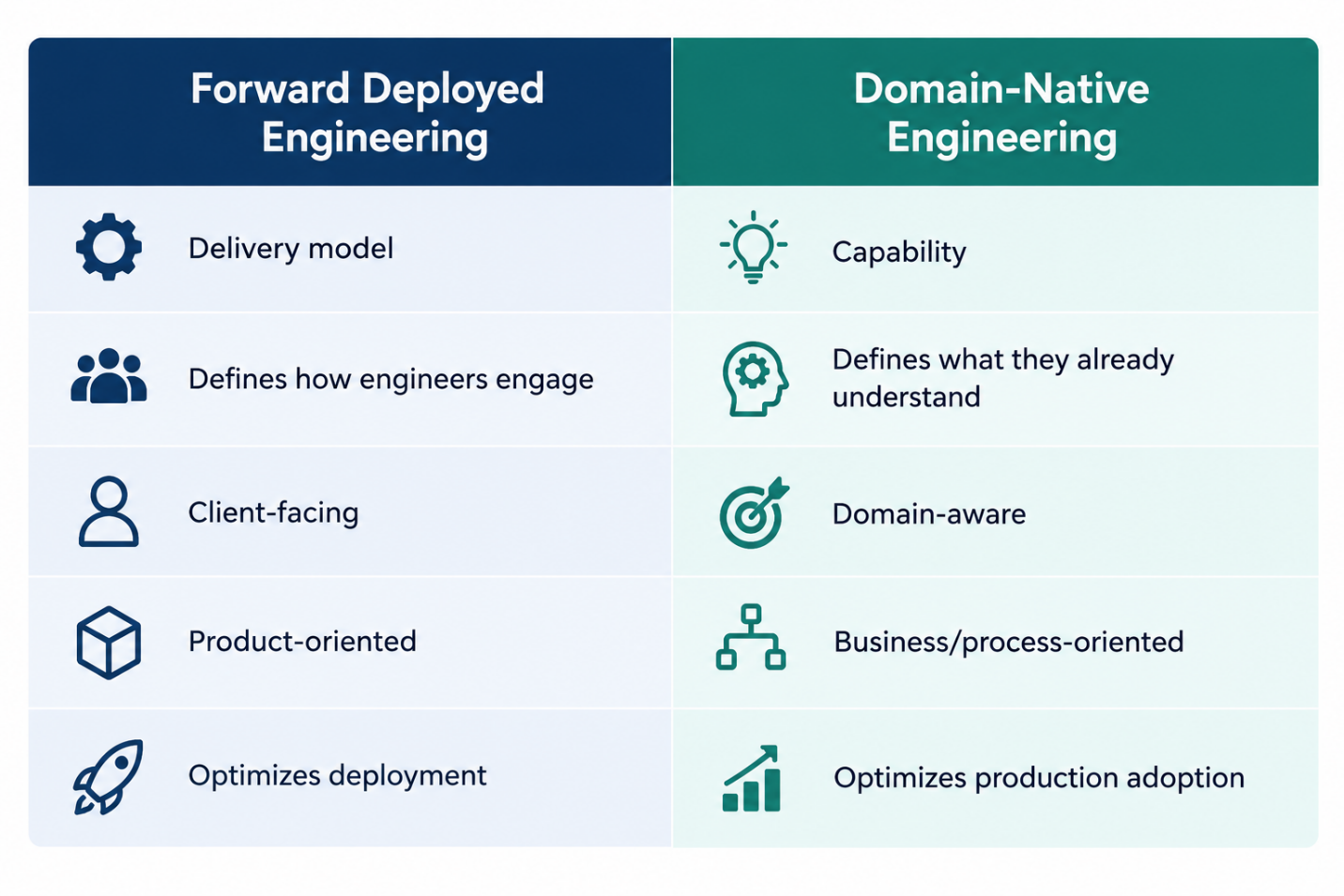
What domain knowledge decides inside a live AI deployment
Take a use case that many banks and payment providers are working on now: AI-assisted alert triage in fraud and AML operations. On paper it is a classification problem. In practice, four decisions shape whether it ever goes beyond the pilot stage:
- Scoping. Which alerts can a model close on its own, and which need an analyst because a regulator will ask who made the call?
- Data. Transaction context arrives from card network messages, ISO 20022 payment messages and case management systems, each with its own quirks. Someone has to know which fields carry the signal.
- Controls. Decision logs, review thresholds and a defined fallback for when the model times out have to exist before go-live, because an examiner will look for all three.
- Handover. The bank’s own operations and risk teams need to run, tune and explain the system once the deployment team moves on.
None of these is a modelling question but a domain question that revolves around the model, and that is where pilots tend to stall.
We saw this with a multinational remittance company whose rule-based detection buried real fraud cases under false positives. The machine learning-based suspicious activity reporting system we built used classification models trained on the client’s historical fraud patterns, with automated alert scoring and continuous retraining built into the compliance workflow. False positive alerts fell by 20% and operational costs by 25%.
Where the impact shows up for the bank
When the engineers already know the domain, the impact spreads well beyond the technology team. Where does a bank actually feel it?
- CIOs and CTOs get a shorter time-to-market, because the scoping and data mapping that usually stall a pilot are handled by people who have built these systems before.
- Risk and compliance leaders get models that arrive with documentation, decision logs and controls that match supervisory expectations.
- Operations heads get systems their teams can run and explain, which is what drives adoption.
- CFOs see AI spend turn into production systems instead of a growing list of pilots.
The second-order effect matters more over time. Domain knowledge built during one deployment stays inside the bank, so each new use case starts further along than the last.
The harder question is who runs the system after the forward deployed team leaves
Forward deployment is designed to end. In that same 2021 post, Palantir describes Deltas working to “enable the client’s IT teams to build independently.” The AI labs’ new services companies will reach that moment with every bank they serve.
So what happens to an AI system that touches settlement, disputes or sanctions screening on the day its builders leave? Someone has to own it, retrain it, extend it to the next scheme mandate and defend it in the next audit. That work needs people who understand the system and the domain at the same depth.
We expect banking to settle into a clear pattern. The AI labs and their forward deployed teams bring the models and the deployment playbook. A domain-native engineering partner carries the system for the long run. When a large global fintech providing card issuing, acquiring and interchange processing moved its scheme compliance work to us, the transition was completed in under two months. It covered 17+ card schemes, including Visa, Mastercard, American Express and Discover, across more than 48 of its own customers, without interrupting business-as-usual. The client recorded 35% efficiency gains right after the transition and has sustained 20% to 30% year-over-year cost savings since. A handover like that is only possible when the incoming team already understands what each scheme demands.
How Opus Technologies approaches AI deployment in banking
At Opus Technologies, our approach to AI follows from the argument above. Opus AI, our portfolio of context-driven AI solutions for software engineering and business operations, rests on the Opus Trifecta: a domain-native engineering skillset, a value-creation mindset and an AI-augmented toolset. Because our engineers have spent years inside payments and banking systems, the regulatory context a model needs, along with governance-first prompt design, is part of every build from the first sprint.
The same thinking applies inside engineering itself. For a global payment connectivity platform supporting more than 30 payment methods on a legacy monolith, we built AI agents for code review, testing and deployment automation across the full software delivery lifecycle. Story point velocity per scrum team rose from 30 to 53, a 77% gain, with a lower cost per feature.
What changes when banks choose an AI deployment partner
The bigger shift is in how banks judge the people they let near their systems. The evaluation questions are already moving:
- “Which model do you use?” gives way to “Who on your team has built in this domain before?”
- The number of pilots gives way to the number of systems in production.
- Time to a demo gives way to time to an approved, audited deployment.
- The engagement end date gives way to a clear plan for who owns the system afterwards.
Forward deployed engineers will be part of banking’s AI future, and the ones who already speak the language of the domain will be the ones whose work stays in production.