






June 20, 2025


Recommended Blogs



Payment tokenization secures digital transactions, reduces fraud, and elevates real-time payments, paving the way for safer open banking and intelligent fintech ecosystems.
Valued at $3.32 billion, the global tokenization industry is anticipated to grow 3X by 2032.
eCommerce has come a long way since its origins in the 1970s, evolving rapidly with technological progress and shifting consumer expectations. But as digital payments grow, so do the risks—fraud and data breaches have made online transactions a prime target for cybercriminals.
To stay secure without compromising user experience, businesses are turning to Payment Tokenization—a critical technology that protects sensitive data while keeping checkout seamless.
With Open Banking enabling broader data sharing across financial ecosystems, tokenization adds a vital layer of protection by securing data as it moves across APIs and third-party platforms.
Discover why Open Banking is the Future of Finance in this white paper.
Let’s dive into what tokenization is, how it works, and why it’s essential in this blog.
What Is Payment Tokenization
Payment Tokenization is the process of replacing sensitive card information, such as the Primary Account Number (PAN), with a randomly generated, non-sensitive equivalent known as a token. This token has no exploitable value on its own, even if intercepted during a transaction, and hence cannot be used even when a hacker gets hold of it.
Let’s take an example and look at an account number and its tokenized value to understand the zero correlation to human eyes without having access to the token vault where the mapping is stored.
- Original PAN: 4111 1111 1111 1111
- Token value for the above PAN: ab12-cd34-ef56-gh78
Zero correlation means that there is no pattern, rule, or visible link that can help reverse engineer or guess the original data from the token.
These tokens can only be mapped back to the original card data through a secure token vault, which keeps the PCI-DSS scope minimal and is typically maintained by a payment processor or token service provider.
To summarize, Tokenization secures digital payments by converting sensitive payment data into randomized tokens, rendering the original information unusable if compromised.
As a core component of the global payments ecosystem, network tokenization plays a vital role in reducing fraud, enhancing authorization rates, and enabling seamless customer experiences. With advanced capabilities like issuer validation during cardholder identity verification (ID&V), network token transactions can offer stronger security than traditional PAN-based transactions. Since tokens contain no personal or financial data, they remain worthless to fraudsters—even in the event of a data breach.
How Does Tokenization Work?

- Card Entry: The customer enters card details during checkout or saves them in a digital wallet.
- Token Generation: A tokenization system replaces sensitive card data with a unique, non-sensitive token.
- Storage & Transmission: Only the token is stored or transmitted through the payment network—never the actual card number.
- De-tokenization & Payment: When a payment is made, the token is sent to a secure vault that maps it back to the original card number to complete the transaction.
- Security & Compliance: Merchants never store or access real card data, reducing the scope of PCI DSS compliance and lowering fraud risk.
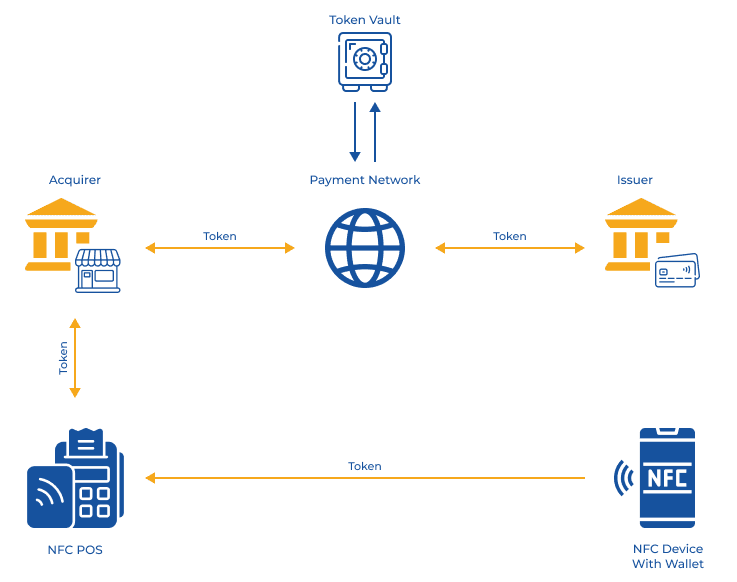
Tokens can be used immediately for payments or securely stored by merchants and digital wallets for future transactions. As illustrated in the diagram below, during a payment, the token is transmitted through the payment network just like a traditional card or account number. However, unlike actual payment credentials, tokens conceal the underlying account information, significantly enhancing security and reducing the risk of data theft and fraud.
Key Benefits of Payment Tokenization
Tokenization delivers an extensive range of benefits to all parties:
Reduced CNP Fraud
Lowers card-not-present fraud by up to 28% for eCommerce, without adding friction to the consumer experience.
Higher Authorization Rates
Increases approval rates by an average of 3% by minimizing unnecessary transaction declines.
Seamless & Intuitive Checkout
Enables faster, smoother checkouts with support for card-on-file, recurring billing, and one-click payments, boosting trust and loyalty.
Enhanced Security
Tokens are worthless if stolen, safeguarding card data even in the event of a breach.
Lower Compliance Overhead
Merchants avoid storing PANs, reducing exposure to PCI DSS audits and cutting compliance costs.
Powering Mobile & Digital Wallets
Core is used to secure payment experiences on platforms like Apple Pay, Google Pay, and Samsung Pay.
Improved Risk Management
Restricts token usage to specific contexts (e.g., device-bound or merchant-specific), reducing misuse and fraud.
Types of Tokenization
Tokens are categorized into three main types based on their origin.
1. Network Token
- Generated and managed by card networks like Visa, Mastercard, Discover, etc.
- Commonly used in digital wallets such as Apple Pay, Google Pay, and Samsung Pay.
2. Issuer Token
- Created by card-issuing banks or financial institutions (e.g., Citi, Bank of America, American Express) to support bank-led digital payment ecosystems.
- Can be linked to mobile wallets or banking apps for secure and device-specific transactions.
3. Merchant Token
- Issued by merchants or their token service providers.
- Replaces cardholder data within merchant apps or e-commerce platforms, ensuring secure, tokenized transactions within the merchant’s environment.
In terms of their usage and storage, they can be classified into these five types:
1. eCommerce (Enabler) Token
Enables fast and secure online checkout across multiple merchants. They are designed for consumers, tokenize card credentials, and are provisioned to consumer devices or browsers. They help streamline digital checkout experiences through online and in-app purchases.
2. Card-on-File (COF) Token
Designed for and provisioned to merchants to secure stored card credentials and support new shopping experiences like recurring billing and one-click checkouts on online and in-app purchases.
3. ACH Token
Designed for Businesses and financial institutions to secure account-based transactions for real-time and ACH payments by tokenizing account credentials, enabling safer fund transfer, and reducing fraud.
4. Secure Element (SE) Token
Designed for mobile wallets and wallet providers, SE token enables secure transactions via embedded secure elements in mobile devices through tokenized card credentials. This has made modern trusted contactless payment possible through NFC.
5. Host Card Emulation (HCE) Token
Designed for mobile wallets and wallet providers, the HCE token provides secure digital commerce via software-based mobile wallets through tokenized card credentials, enabling wallet payments via cloud, in-store, or in-app purchases.
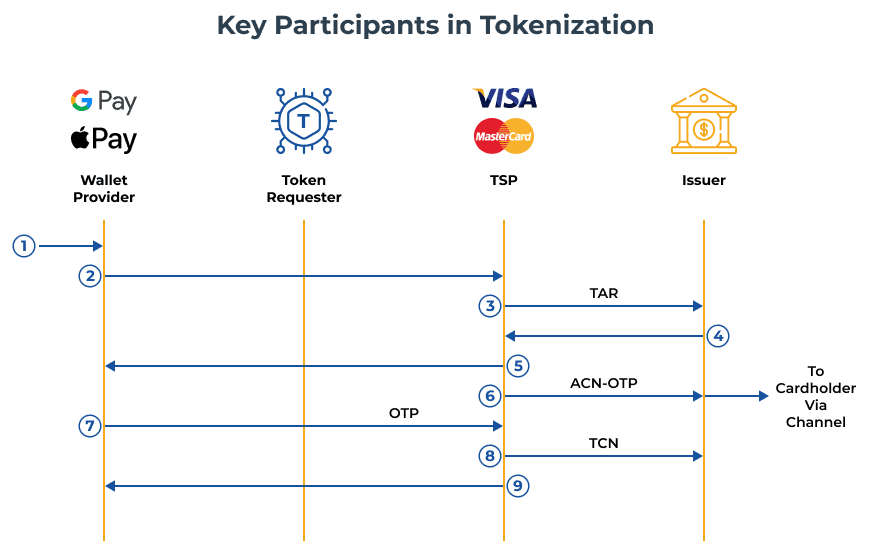
Key Participants in Tokenization:
Wallet Provider
Applications, such as Apple Pay, Google Pay, and Samsung Pay, securely store card data in tokenized form and allow payment transactions.
Token Requester
Systems (e.g., merchant apps or wallets) that collect card data and send it to the Token Service Provider (TSP) to request a token.
Token Service Provider (TSP)
Entities like Visa or Mastercard generate tokens, provision them, and maintain the mapping between the card and the token.
Issuer
The financial institution or bank that issues the physical or digital card to the cardholder.
The image below showcases the Token Provision Flow from a Wallet.
Where Is Tokenization Used?
Given the sensitive nature of information, tokenization has several applications to safeguard sensitive information, thereby reducing the risk of exposure across the fintech and money movement landscape.
E-commerce Platforms
Securely store customer payment details to enable faster, safer checkouts.
Mobile Payment Apps
Use device-specific tokens (e.g., Apple Pay, Google Pay) for each card to enhance security and enable contactless payment.
Recurring Billing Systems
Manage subscriptions and auto-payments without storing raw card data.
In-store Contactless Payments
Power tap-to-pay transactions using tokenized credentials in smartphones and wearables.
Tokenization vs. Encryption: Know the Difference
Tokenization is not the same as encryption. While both enhance security in payment ecosystems, they serve different purposes and operate differently. Here’s how they differ:


Future Trends in Payment Tokenization
Open banking, real-time payments, and emerging technologies, such as AI/ML, are creating fresh use cases for tokenization.
Network Tokenization
Offered by card networks (Visa, Mastercard) to generate dynamic tokens for each transaction.
Token Lifecycle Management
Auto-update tokens when cards are reissued or expired.
AI-powered Fraud Detection
Enhances security by combining tokenization with behavioral analytics to detect anomalies.
Cross-Platform Token Management
Seamlessly use tokens across devices, platforms, and channels.
Agentic AI-Based Tokenization
This will be a game changer in the future, and several futuristic trends are being explored today in the tokenization space using Agentic AI.
- Automatically create, update, and revoke tokens in real-time based on contextual triggers.
- Manage token lifecycles without manual intervention—ensuring tokens are always valid and current.
- Modify token usage rules or de-tokenization flows in real-time when suspicious activity is detected.
- Decide when and how to reuse or generate new tokens across devices, apps, or regions for a consistent yet secure user experience.
- Align tokens across in-store, mobile, and online channels intelligently based on customer preferences.
- Automatically maintain audit trails and compliance logs to meet PCI DSS and GDPR requirements and proactively identify risks during provisioning.
- Assign different tokenization strategies (e.g., duration, scope, domain restrictions) based on customer risk profiles.
- Adjust token validity windows, usage limits, and pairing with multi-factor authentication based on usage patterns.
Tokenization: Securing the Future of Payments
Payment tokenization is not just a buzzword—it’s a critical layer of defense in the modern financial ecosystem. By abstracting sensitive information from everyday transactions, it empowers businesses to provide a seamless, secure, and compliant experience for customers.
Whether you’re a fintech startup, a global e-commerce company, or a mobile app developer, embracing tokenization is a strategic move towards a safer and intelligent payments future.
Exploring ways to improve your tokenization strategy?
Learn how our expertise can help you streamline, secure, and scale. Contact us for a personalized consultation.

Debashis Bhattacharyya
Debashis Bhattacharyya has over 18 years of experience planning and delivering technology solutions, specializing in Cloud, API, DevSecOps, and Payment Application Modernization. He has been instrumental in Opus’ transformational DevOps initiative with FIS, which won the prestigious DevOps Dozen Award for ‘Best DevOps Industry Implementation’ in 2022.
About us
Opus is a trusted engineering partner to payment providers, banks and fintechs navigating change in a real-time, digital-first world.
Our promise is simple: Business Value Acceleration. Realization. Maximization.
We deliver on this promise through the Opus trifecta-a domain-native engineering skillset, a value-creation mindset, and an Al augmented toolset that drives business agility.
From MVP (Minimum Viable Product) to MPT (Maximum Possible Transformation), Opus turns engineering into business advantage.