



December 19, 2025
Recommended Blogs
Tags:
Future-proof your payments infrastructure with key enhancements to align your payment applications with PCI DSS 4.0.
Insufficient process maturity and reactive compliance have had an adverse impact on nearly 9 in 10 organizations.
As the digital payment landscape evolves, so do the compliance standards that govern it. The Payment Card Industry Data Security Standard (PCI DSS) is the global baseline defining how to safeguard cardholder data and ensure that merchants, service providers, and payment applications operate safely and compliantly. Adopting PCI DSS 4.0 is essential for FIs to maintain trust, compliance, and operational continuity.
PCI DSS 4.0: Why Another Version
PCI DSS 4.0 was released in March 2022. It represents the most significant update to the Payment Card Industry Data Security Standard (PCI DSS) since version 3.2.1. It is designed to tackle today’s complex threat landscape and evolving payment technologies. The latest version—4.0—modernizes the framework to better align with how organizations intend to operate in 2025 and beyond.
“Information is the oil of the 21st century, and analytics is the combustion engine.”
~ Peter Sondergaard
Modern Data Platforms are the infrastructure delivering appropriate data at the right time to power real-time insights.
Discover how to implement a Modern Data Platform for Financial Companies Using a Multi-Tenant Architecture in this white paper.
Organizations were given a transition period until March 31, 2025, after which all PCI DSS assessments must be conducted using version 4.0. The 3.2.1 Version is no longer valid. Organizations must adapt to the new requirements.
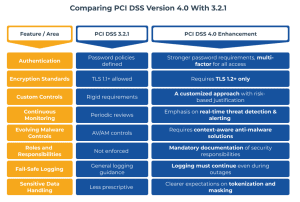
All That’s New in PCI DSS 4.0 (vs 3.2.1)
Some of the key changes in version 4.0 that impact payment application development and deployment are:
![]()
How to Prepare Your Payment Application for PCI DSS 4.0
Imagine telecom companies using manual switching to route mobile phone calls. Inefficient, error-prone, and non-scalable. Evolving the enabling mechanism is crucial to deliver cutting-edge services. PCI DSS 4.0 truly empowers FIs to provide reliable and secure card payment experiences. For FIs developing or operating a card-issuing, processing, or management application, certain action items are non-negotiable to stay relevant:
1. Strengthen Authentication Controls
The world is moving faster than you’d imagine. Right about the time, palm authentication is gaining ground over face or fingerprint authentication. Implementing multi-factor authentication (MFA) for all users, including developers and admins, is a no-brainer. However, security experts often overlook robust lockout mechanisms.
Take a closer look at Why Security-First Development Matters for fintech in this blog.
2. Upgrade Cryptography
As developers, keeping the algorithms updated is paramount. Much like payments infrastructure, outdated encryption algorithms (e.g., SHA-1, 3DES) are still in use. It is high time FIs level up TLS 1.2 or higher, and that holds for all encryption use cases.
3. Adopt a Continuous Testing Culture
Fast-paced development with integrated release pipelines does not mean that testing takes a backseat. Use secure coding practices and SAST/DAST tools to build high-quality solutions. Performing regular penetration testing, code reviews, and vulnerability scans is even more critical in CI/CD pipelines. This is Why the Financial Sector Needs DevSecOps More than Ever Before.
4. Enhance Logging and Monitoring
Uninterrupted operations and optimal uptime call for ongoing monitoring. Ensuring that all generated logs are preserved even during system failure is essential. To start with, switch to centralized logging with tamper-evident storage. Integrate SIEM or real-time alerting to detect any breaches before they penetrate the system.
5. Map and Minimize Cardholder Data Flow
The safest place for data is in isolated vaults. However, that is impossible in today’s data-first world. The key is to manage data better. This includes limiting retention periods, defining purge policies, and tokenizing PAN data wherever possible.
6. Document Roles and Ownership
While DevSecOps pipelines enforce shared security responsibility, defining clear ownership in each phase ensures accountability. Keeping policies and training material updated ensures the team is informed about their respective roles and responsibilities.
7. Adopt a Customized Approach
While standards enforce uniformity, in practice, many exceptions may arise. And these are imperative to manage. The best practice is to document a risk-based justification when deviating from any standard control. Ensure compensating controls meet or exceed the intent of the original requirement.
Turning Compliance into Competitive Advantage
Transitioning to PCI DSS 4.0 is not a mere regulatory mandate. It is an opportunity to future-proof your payments infrastructure. In an environment where threats evolve fast and customer trust sways at the drop of a hat, aligning your systems with PCI DSS 4.0 is imperative to stay relevant, trustworthy, and protected.
Strengthening your authentication model, implementing adaptive encryption, and adopting continuous security monitoring elevate your entire security posture. PCI DSS 4.0 empowers you to lay the foundation for innovation in digital payments.
Opus Technologies has partnered with leading fintech organizations and payment providers, including Fortune 500 companies, to simplify and expedite their PCI DSS 4.0 transition. From gap assessments and roadmap creation to the implementation of technical controls and continuous monitoring frameworks, we do it all. Our domain expertise ensures your compliance journey remains strategically aligned with your long-term goals. Connect with our experts to learn more.
About the Author
Suthan Subramani Harihara
Suthan Subramani Harihara has over 17 years of experience leading digital transformation initiatives in core and open banking ecosystems, with his expertise spanning Core Banking APIs, Open Banking platforms, and AI-powered fraud detection solutions. He has been instrumental in Opus Technologies’ Core Integration Program, which optimized product delivery through effective backlog management and stakeholder collaboration, resulting in enhanced banking product performance.
About us
Opus is a trusted engineering partner to payment providers, banks and fintechs navigating change in a real-time, digital-first world.
Our promise is simple: Business Value Acceleration. Realization. Maximization.
We deliver on this promise through the Opus trifecta-a domain-native engineering skillset, a value-creation mindset, and an Al augmented toolset that drives business agility.
From MVP (Minimum Viable Product) to MPT (Maximum Possible Transformation), Opus turns engineering into business advantage.