






April 2, 2026


Recommended Blogs




The US banking industry is undergoing a structural shift driven by three converging forces: real-time payments (RTP & FedNow), digital assets (stablecoins & tokenized deposits), and embedded finance. These are the documented US market developments reshaping settlement timing, risk sequencing, and distribution ownership.
How is the payments landscape changing
Real-time payments
The Clearing House reported that the RTP network processed 343 million transactions totaling $246 billion in 2024, confirming production-scale adoption across US institutions.
FedNow
Launched in July 2023 by the Federal Reserve, FedNow makes instant payments a directly supervised capability within the financial infrastructure of the US.
Stablecoins & tokenized deposits
Given that the Federal Reserve has examined how stablecoins may impact deposits and financial intermediation, their systemic relevance is clear. JPMorgan’s Kinexys platform already demonstrates tokenized deposit experiments within regulated frameworks. Staying ahead of the competition means keeping pace.
Take a deeper dive into Reimagined Gateways for Navigating the Future with AI and Tokenized Money.
Regulatory context for instant payments
The Federal Reserve’s supervisory guidance has set some key premises for institutions offering instant payment services. These include border controls, such as pre-execution fraud, ongoing liquidity monitoring, and 24/7 operational resilience.
Stablecoin policy context
Federal Reserve research highlights that stablecoins could affect deposit funding, credit intermediation, and liquidity dynamics in the US banking system. This reinforces the importance of dual-ledger auditability and governance in all implementations of programmable settlements.
Embedded finance in the US
In the US, payroll platforms, marketplaces, and vertical SaaS providers are driving the growth of embedded payments. Banks are increasingly shrinking to regulated balance-sheet providers behind API layers rather than primary customer interface owners.
The Fed’s analysis of pay-by-bank use cases explains how direct bank account payments are being embedded into merchant checkout experiences. The note highlights cost advantages, settlement efficiency, and implications for liquidity and fraud controls. According to the note embedded account-based payments are a structural evolution in US retail payments.
Bain highlights that embedded finance is set to become a multi-trillion-dollar opportunity in the US. The research emphasizes that banks are increasingly repositioning themselves as balance-sheet providers behind digital ecosystems, while platforms own customer experiences.
The new core stack: From monolith to Financial OS
Legacy banking cores were built as single, tightly connected systems, which were great for control and consistency, but designed for end-of-day processing. That model worked in a batch-driven world. Today, it is increasingly out of step with what banks need to deliver: real-time payments, programmable money, and embedded finance, all with the speed and reliability customers now expect.
The “New Core” is evolving into a modular, real-time, programmable financial operating system (Financial OS). It provides the set of capabilities that work together to move money, manage risk, and keep the financial state in sync across multiple rails and partner ecosystems.
The Financial OS
The architecture of Financial OS is layered and loosely coupled. Each layer has a clear responsibility and can evolve independently. The architecture principles below describe how those layers should behave so the bank can execute transactions in real time, apply controls consistently, and plug into multiple payment rails, without putting the regulated system of record at risk.
Architectural principles of Financial OS
- Event-driven operation (not batch cycles)
- Authorize and orchestrate in-line, then record to the ledger
- Controls built in (not checked after the fact)
- API-first design for internal and external consumers
- Rail-agnostic execution via pluggable adapters
Together, these principles make it possible to add real-time capabilities incrementally. A good example of the same is introducing orchestration, event management, or a sidecar ledger, while keeping the regulated core stable and fully auditable.
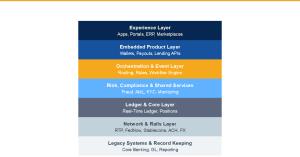
Financial OS – Layered architecture
Experience layer
The top layer is channelagnostic and APIdriven. This enables flexible integration across web, mobile, enterprise systems, and automated agents. The layer employs realtime feedback, leveraging event streams and notifications to keep users informed. Most importantly, it remains decoupled from the intricate logic of payment orchestration or settlement flows. This creates a clean separation between user-facing experiences and backend financial complexity.
Embedded product layer
This is the second layer and it exposes financial capabilities as composable products that can be embedded into non-financial experiences. This layer turns core capabilities into reusable, well-defined products and applies product-specific rules and configuration through APIs. This allows partners to integrate without needing to understand the bank’s underlying systems.
Orchestration & event Layer
The Orchestration & Event Layer is the real-time control plane of the Financial OS, coordinating what happens next as transactions move from intent to execution. This layer is responsible for how and where a transaction should run. It manages multi-step payment journeys, publishes and feeds on real-time events. It also handles the real-life complexities, such as retries, timeouts, and exceptions, while keeping the overall state stable.
Ledger & core layer
This layer is the financial source of truth that tracks value, positions, and obligations in real time. This is where value is actually recorded. It needs to post atomically, validate balances reliably, preserve integrity and auditability, support immediate and irrevocable settlement, and keep real-time positions available to the layers above.
Network & rails layer
The Network & Rails Layer connects the Financial OS to external systems, such as payment and settlement networks. This layer works as a translator between internal transaction intent and each connected network’s required formats. The Network & Rails Layer also manages connectivity and SLAs, while handling acknowledgments, settlement outcomes, and exceptions. This separation layer ensures that upstream layers stay focused on business logic.
Shared services layer
Shared Services act as a connection bus equipped with cross-cutting capabilities that apply across all layers. Their job is to enforce enterprise-wide policies, provide reusable capabilities at scale, and keep the whole stack compliant, resilient, and transparent. This helps avoid rebuilding the same controls separately for each layer.
Use case examples: Financial OS in action
The use cases prove a point – you need to level up to stay competitive.
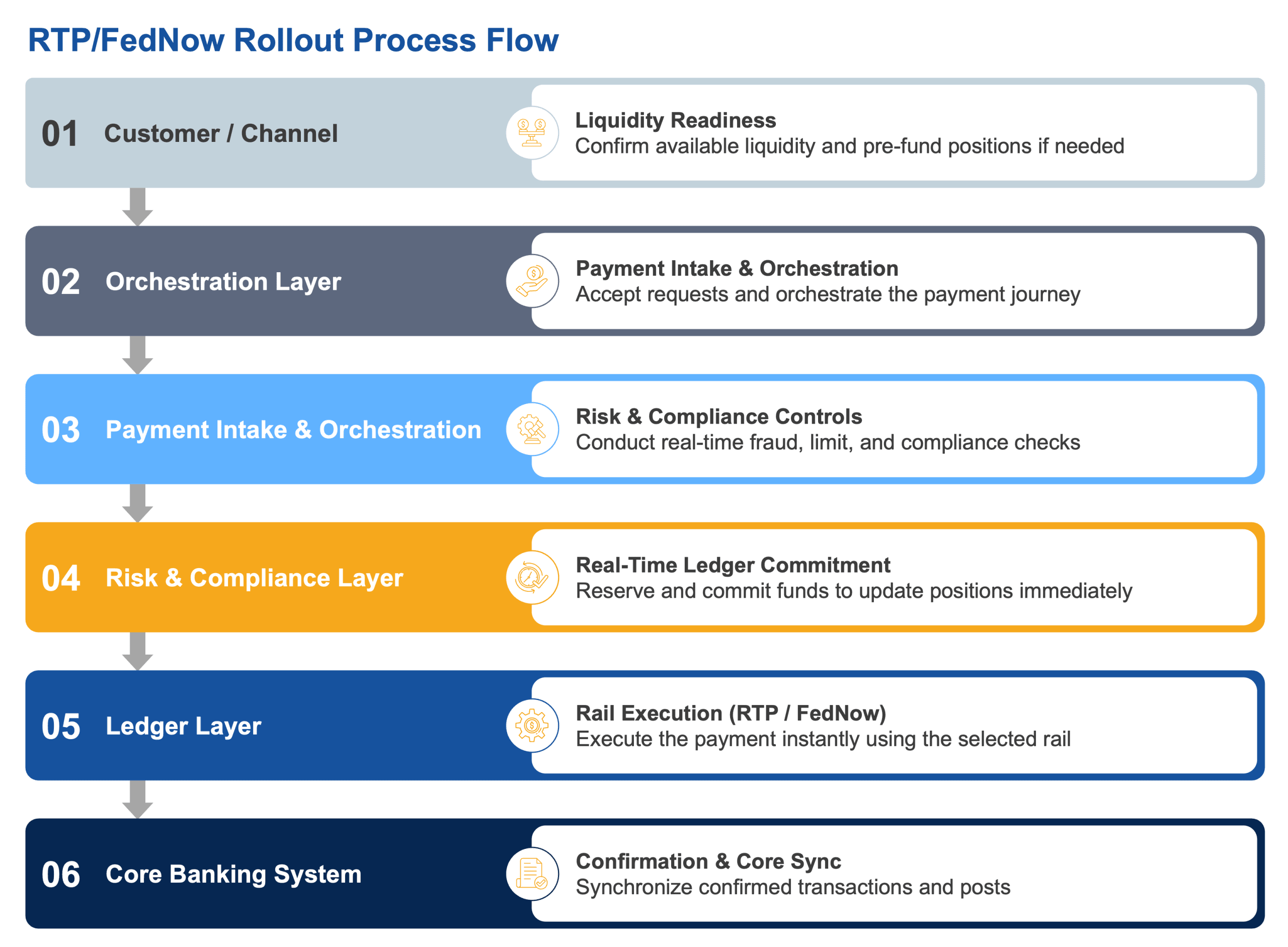
Case 1: RTP / FedNow rollout without core replacement
Problem
The bank needs to launch FedNow and RTP, but its core remains batch-based, making reliable real-time balance checks and true 24/7 availability hard to deliver.
Financial OS approach
Outcome
The bank can go live with instant payments quickly, with real-time funds certainty and 24/7 operations, while keeping the legacy core stable and avoiding a full core replacement.
Case 2: Stablecoin-based settlement for cross-border flows
Problem
The institution wants faster cross-border settlement and less capital tied up in prefunding. It’s evaluating stablecoin settlement to simplify reconciliation and improve end-to-end transparency across corridors.
Financial OS approach

Outcome
Settlement moves toward near-instant execution across time zones, with lower prefunding needs and auditability that spans both the chain and the institution’s internal books.
Case 3: Embedded payouts for a marketplace platform
Problem
The marketplace wants to offer instant seller payouts and embed payments directly into its workflows. At the same time, it wants to avoid taking on the burden of becoming a regulated bank.
Financial OS approach

Outcome
Sellers get instant or same-day payouts, while the marketplace improves liquidity and retention without inheriting banking complexity.
You need a Financial OS to stay relevant
Banking is shifting from a slow, batch-driven model to a real-time, always-on ecosystem. Consumers expect money to move instantly, decisions to happen in-line, and their experiences to be embedded within everyday platforms. Real-time rails, tokenized value, and embedded finance are collectively reshaping the factors that differentiate leaders from laggards. Against this backdrop, a Financial OS becomes a strategic necessity. It enables banks to innovate at the edge while preserving control at the core. This allows them to participate in new value chains without compromising compliance or stability. The institutions that successfully make this transition are set to shape the future of financial infrastructure. Get on a call with the experts at Opus Technologies to gain the competitive edge.

Suthan Subramani Harihara
Suthan Subramani Harihara has over 17 years of experience leading digital transformation initiatives in core and open banking ecosystems, with his expertise spanning Core Banking APIs, Open Banking platforms, and AI-powered fraud detection solutions. He has been instrumental in Opus Technologies’ Core Integration Program, which optimized product delivery through effective backlog management and stakeholder collaboration, resulting in enhanced banking product performance.

Santoshkumar Pawar
Santoshkumar Pawar is a Sr. Consulting Enterprise Solution Architect at Opus with over 25 years of experience designing scalable, cloud-native platforms across FinTech banking domains. He has played a key role in architecting AI-ready data platforms, enabling real-time fraud detection, predictive analytics, and intelligent automation in payment systems. Expert in microservices architecture, cloud migration, and digital transformation. Adept at aligning technology strategy with business goals.
About us
Opus is a trusted engineering partner to payment providers, banks and fintechs navigating change in a real-time, digital-first world.
Our promise is simple: Business Value Acceleration. Realization. Maximization.
We deliver on this promise through the Opus trifecta-a domain-native engineering skillset, a value-creation mindset, and an Al augmented toolset that drives business agility.
From MVP (Minimum Viable Product) to MPT (Maximum Possible Transformation), Opus turns engineering into business advantage.