






April 16, 2025


Recommended Blogs



Discover how automation is transforming BIN management, reducing errors, and boosting operational efficiency across payment networks. Learn best practices and insights from Opus Technologies.
Introduction
Ever wondered how a Point-of-Sale (POS) machine instantly identifies your bank when you swipe your card and await payment confirmation?
The POS terminal uses the first 6-8 digits of your card number to uniquely identify your issuing bank. These digits are the Bank Identification Number or BIN, and they play a crucial role in the payment ecosystem by routing transactions accurately. Here’s what the BIN also helps merchants identify:
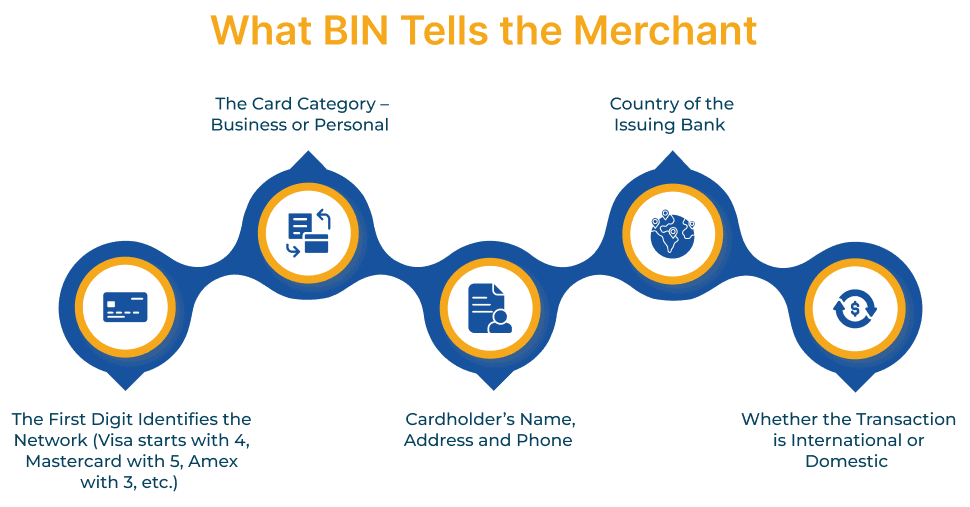
Given the massive volume of digital transactions today, efficient BIN management processes are indispensable for payment networks, financial institutions, and merchants. This blog explores such processes and outlines the best practices to streamline BIN management.
What is BIN Management?
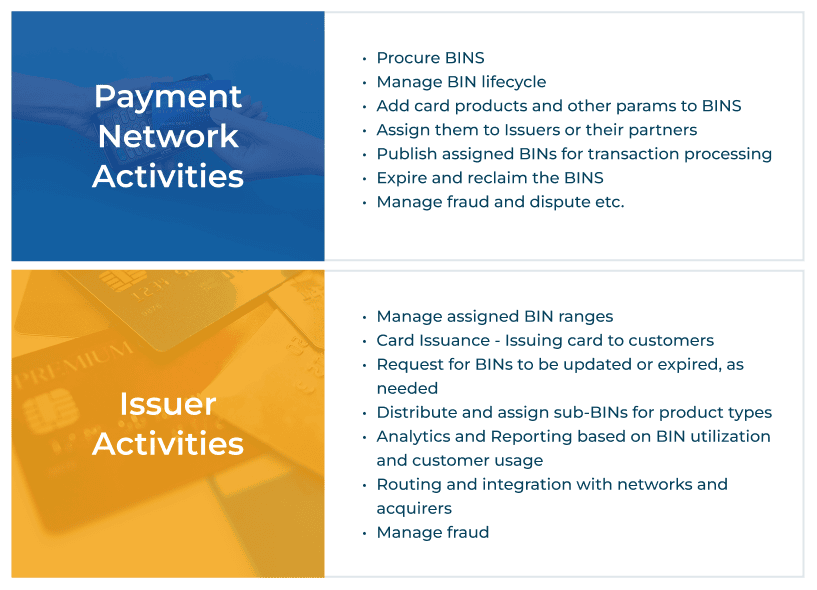
BIN management refers to the systematic handling of BINs to ensure seamless transaction processing, compliance with regulatory requirements, and optimized customer experience. The activities can be segregated into two sets – payment networks and issuers.
Why is Automated BIN Management Important for Networks
BIN Management is an important process for any network, but these processes have a lot of silos that need improvement to cater to the requirements of the modern world. Traditional and manual ways of managing BINs not only delay time-to-market but are also plagued with issues like duplicate allocations and human error. A sophisticated approach is required to refine and bring a renaissance to the way BIN Management is performed across the payments industry.

AI-Driven BIN Management
AI-driven automation transforms BIN management processes, improving accuracy, efficiency, and security. Let us see how AI will enhance various BIN management activities in the future.
BIN Allocation
AI can automate the BIN request and assignment process, making it faster and more accurate. In addition, AI-powered systems can forecast BIN demand, based on transaction trends and help with request and assignment of BINs accordingly. AI can also help in identifying underutilized BINs, and split and assign them for better utilization. BIN distribution can be seamlessly managed via AI algorithms.
Real-Time BIN Monitoring & Fraud Detection
AI can analyze BIN usage patterns to detect anomalies preventing fraudulent activities. It can also aid in identifying and blocking compromised BINs.
BIN Inventory & Compliance Management
AI can track and reconcile the BIN inventory across issuers, while managing compliance with regulatory norms across the BIN management lifecycle.
BIN Expansion & Migration
The cumbersome task of transitioning from 6-digit to 8-digit BIN can be automated with AI. The technology also eases the performance of Split or Rollup between 6-8 digits, based on demand. Plus, AI can identify optimal BIN segments for new card programs or products.
BIN Performance Analysis & Reporting
AI continuously analyzes BIN performance metrics, such as approval rates, chargebacks, and fraud rates. Smart dashboards provide real-time insights for issuers and payment networks, while AI-driven recommendations help issuers optimize BIN strategies for better efficiency.
Predictive Maintenance
FIs can minimize errors and incomplete operations by deploying AI to detect potential BIN lifecycle processing failures, based on historical data. The AI-powered system can then send real-time alerts to issuers and networks about BIN-related risks for early intervention. Moreover, AI can improve system resilience by preventing BIN configuration errors.
Conclusion
Effective BIN management is essential for seamless payment network operations. This blog highlights the growing need for automation and its benefits for organizations. As AI integration with BIN becomes increasingly vital for the future, a thorough cost-benefit analysis is crucial to ensure alignment with organizational goals and objectives.
Are you exploring options to improve and streamline your BIN management processes through automation? Opus Technologies has three decades of experience powering banks, FIs, and payment enablers to implement the latest technology tools to strengthen operations and future-proof their organization. Let’s discuss how we can collaborate to drive success for your brand. Contact us today for a detailed consultation.

Debashis Bhattacharyya
Debashis Bhattacharyya has over 18 years of experience planning and delivering technology solutions, specializing in Cloud, API, DevSecOps, and Payment Application Modernization. He has been instrumental in Opus’ transformational DevOps initiative with FIS, which won the prestigious DevOps Dozen Award for ‘Best DevOps Industry Implementation’ in 2022.
About us
Opus is a trusted engineering partner to payment providers, banks and fintechs navigating change in a real-time, digital-first world.
Our promise is simple: Business Value Acceleration. Realization. Maximization.
We deliver on this promise through the Opus trifecta-a domain-native engineering skillset, a value-creation mindset, and an Al augmented toolset that drives business agility.
From MVP (Minimum Viable Product) to MPT (Maximum Possible Transformation), Opus turns engineering into business advantage.