






February 18, 2026


Recommended Blogs



Mordor Intelligence estimates the Canadian Real Time Payments Market to reach $33.19 billion, growing at a CAGR of 23.89% from 2025 to 2030.
Payments Canada is gearing up for the new Real-Time Rail (RTR) to fundamentally change the country’s payment infrastructure. Immediate, 24/7 data-rich fund transfers position Canada on the global competitive map of real-time payments.
Why does Canada need a new payment infrastructure
Canada’s existing payment infrastructure is sequential and batch-oriented. It postpones the final clearing and settlement of funds. This generates friction and time delays. The Real-time Rail system aims to change this through the cutting-edge national payment infrastructure equipped. Immediate certainty builds the foundation of next-gen Canadian financial services.
- Immediate finality and 24/7 liquidityExisting systems manage credit extensions within the settlement window, whereas the RTR enables real-time transaction settlement among financial institutions. Such near-instant finality:
- Provides payment certainty
- Eliminates systemic risks
- Ensures instant fund availability
- The strategic advantage of structured data (ISO 20022). While speed is paramount, Canada’s Real-time Rail uses the global ISO 20022 messaging standard. This new structure enables payments to convey much richer, structured remittance data.
- Facilitating Straight-Through Processing (STP): Deep, structured data facilitates Straight-Through Processing (STP). Real-time incoming payments can be automatically matched against outstanding invoices using accounting software without human intervention. This boosts operational efficiency while eliminating the hidden costs associated with processing paper-based alternatives, such as cheques.STP lowers the chances of payment disputes. Plus, rich data streamlines reconciliation and reduces investigation time for all parties.The evolved data structure enables overlay services such as Request for Pay (RfP). This means a firm can securely send customers an electronic bill to review the itemized request and authorize an RTR payment instantly. Thus, accelerates the collections and billing cycle. This enhances compliance, audit trails, and financial reporting.
Payment fraud impacts the behavior of 54% of Canadians.
- Active, centralized fraud mitigation: Payments Canada recognized the initial fraud spikes in the initial real-time payment systems in other regions. The new payment infrastructure is set up to launch with a centralized fraud mitigation service integrated into the network architecture from the get-go.RTR prioritizes central controls to ensure system safety, maintain public trust, and meet the Bank of Canada’s high risk management expectations with:Confirmation of Payee (CoP): Verification that the sender’s name matches the name registered on the receiving account. CoP is highly effective against authorized push payment (APP) fraud. It can also remove misdirected payments, a long-standing shortcoming of real-time systems.
Central fraud analytics: RTR employs AI/ML models to continuously examine transaction flows. They generate a Fraud Score for suspected high-risk payments after assessing patterns and identifying irregularities in real time. Timely alerts facilitate immediate intervention before funds are exchanged. This payment infrastructure prepares Canada for financial innovation, such as for Open Banking. - Growing Competition and Access: The new Real-time Rail facilitates easier market entry and greater competition. Legislative amendments to the Canadian Payments Act expand the eligibility for membership and direct involvement in the system.This policy change creates opportunities for a variety of innovators, diversifying the ecosystem through a level playing field for qualified Payment Service Providers (PSPs), credit union locals, and fintech companies. This payment infrastructure also prepares Canada for Open Banking.New players have access to the RTR’s secure, API-based platform for building new, customized products. From sophisticated treasury solutions to highly localized consumer apps, everything enables them to add value to the Canadian marketplace.
Overcoming the adoption challenge: Trust, cost, and friction
While the tech benefits of the RTR are clear, three interconnected challenges need to be addressed:
Trust and timeline skepticism
Even major business users are unwilling to invest the significant time and money required for technical integration until the system is stable and proven. As instant payment systems are irrevocable, companies handling high-stakes transactions like payroll are exercising caution and demanding proven stability before migrating core business processes.
Legacy rail cost competition
Companies currently use the very low-cost Automated Clearing Settlement System (ACSS) and its Electronic Funds Transfer (EFT) rail for high-volume batch transactions. This makes the near-term conversion cost unclear.
High accreditation cost and friction
Several hurdles increase the cost and complexity for both entrants and incumbents. These encompass registration with the Bank of Canada and FINTRAC as a Payment Service Provider (PSP), application to be a member of Payments Canada, and direct settlement accounts.
Shift focus to operational value
The true economic benefit of the RTR is the ability to achieve Straight-Through Processing (STP). It eliminates manual reconciliation, cutting internal processing costs and providing immediate, irrevocable certainty. Realizing this strategic focus on efficiency gains is the most important aspect of unlocking the complete competitive value of the new system.
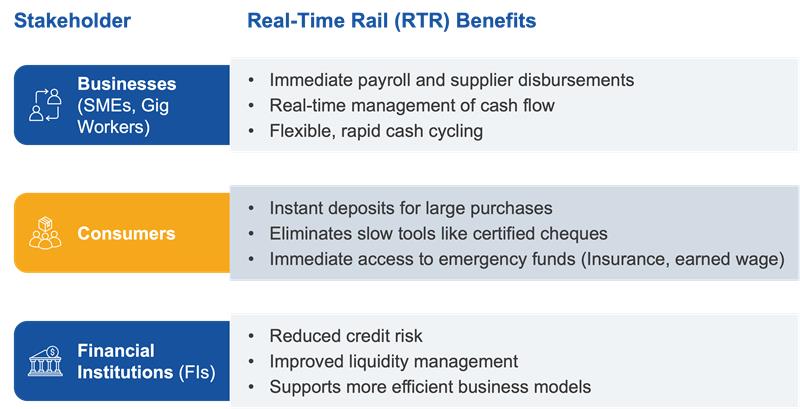
The Real-Time Rail can potentially reduce friction and increase the national productivity of the Canadian economy. Overcoming the adoption hurdle for the new payment infrastructure requires FIs to see beyond the cost of transactions to efficiency gains resulting from data-driven, instantaneous payments. There is still time to finalize technical readiness and develop strategies to capture the immense potential of the RTR.
Contact us to learn how we can help you accelerate your Real-Time Rail readiness.

Vladan Maricic
Vladan Maricic has over 18 years of experience as a Senior Software Engineer and Technical Architect in the financial and payments services industries. Specializing in high-performance, non-blocking backend systems, he is an expert in Java, Spring Boot, and event-driven architectures. Vladan has been instrumental in designing and implementing Next-Gen payments platforms for high-profile customers. He has held leadership roles at NCR Corporation, leading software teams, and now drives technical direction and delivery excellence at Opus Technologies.
About us
Opus is a trusted engineering partner to payment providers, banks and fintechs navigating change in a real-time, digital-first world.
Our promise is simple: Business Value Acceleration. Realization. Maximization.
We deliver on this promise through the Opus trifecta-a domain-native engineering skillset, a value-creation mindset, and an Al augmented toolset that drives business agility.
From MVP (Minimum Viable Product) to MPT (Maximum Possible Transformation), Opus turns engineering into business advantage.