






April 22, 2026


Recommended Blogs



HTTP has had a status code sitting in its specification since the early 1990s: 402, “Payment Required.” Reserved deliberately, never activated, it waited as a placeholder for a payment layer the internet’s original architects believed would eventually sit natively inside the web’s core protocol.
It never arrived. The payments industry built its infrastructure on top of the web rather than inside it: checkout forms, card processors, KYC screens, third-party redirects, and settlement windows that absorb liquidity for days. Fintech companies inherited this model and refined it. It worked well enough for human-initiated commerce, where a person is always in the loop to confirm, authorize, and authenticate.
The problem arises when the transacting party is not human.
When the authorization stacks meet an autonomous agent
An autonomous agent today can analyze the data feed, assess a counterparty risk signal, and trigger a downstream workflow in milliseconds. Then it reaches the authorization and settlement stack, and the clock stops.
Every current payment method requires what agents fundamentally cannot provide: an account tied to a legal entity, an API key bound to a subscription, or an OTP delivered to a human device. An agent that processes information at machine speed still has to wait for a human to type in a card number or approve an authorization step. The payment infrastructure built for human commerce becomes a hard ceiling for machine commerce.
x402 is designed to close exactly that gap.
Inside a single x402 transaction
The protocol activates that long-dormant 402 status code and embeds payment capability directly into HTTP, following the same request-response cycle that powers every web interaction.
The entire cycle, from pricing and payment negotiation to on-chain settlement and content delivery, completes in seconds. No wallets to open, no redirects, no accounts to create. Payment becomes just another HTTP request.
Consider an API serving sports headlines. With a subscription key, it traditionally functions as follows:
GET /api/sportsheadlines HTTP/1.1
Host: api.sportsheadlines.com
Authorization: Bearer <<API Key>>
Response Code: 200 OK
Response: Returns “Headlines”
Now, say you do not have a subscription and therefore do not have an API key. You need this once, pay-per-use. Here is how the same interaction looks with x402:
GET /api/sportsheadlines HTTP/1.1
Host: api.sportsheadlines.com
Response Code 1: 402 Payment Required
Response 1: Price: $0.05 USDC
Response 1: Payment Address: [<<address>>]
Response 1: Payment Network: Ethereum
–The payment is made to the API–
GET /api/sportsheadlines HTTP/1.1
Host: api.sportsheadlines.com
Proof-of-Payment: [<<Details>>]
Response Code:200 OK
Response :Returns “Headlines”
For developers, integration is a single line of middleware. Set a price per endpoint, point to a facilitator, and your API can charge per request in any stable coin, on any supported network, turning payment into a native HTTP process.
The agentic economy and why x402 fits it
Agentic commerce is already happening. Autonomous agents are browsing merchant catalogs, evaluating options, and executing purchases without a single human click. These agents also pay each other: a multi-step agentic workflow might require one agent to call a pay-per-use service operated by another, settling value for a discrete compute task or a one-time data lookup.
This is precisely where the current payment infrastructure breaks down. BCG’s 2025 Global Payments Report identifies agentic AI among the structural forces reshaping global payments, estimating it will influence over $1 trillion in commercial activity as adoption scales. That volume cannot move through authorization stacks designed around human confirmation loops. x402 addresses this by treating settlement as a stateless, programmatic act: sign a transaction, attach it to a request, done. No account setup, no API key overhead, no subscription cycle, no friction between an agent’s decision and its execution.
Traction, coalition, and an honest read of where things stand
The protocol was launched in September 2025, co-founded by Coinbase and Cloudflare through the x402 Foundation. The coalition behind it is unusually broad for a protocol at this stage: Google, Visa, AWS, Circle, Anthropic, Vercel, and Solana are core foundation members. What makes this coalition significant is not the size of the names but the range of what they represent: cloud infrastructure, a card network with five decades of settlement rails, a stablecoin issuer, and the teams building the frontier AI models whose agents will need to transact at scale. Every layer of the emerging agentic economy has a seat at this table.
X402 runs a facilitator that confirms that payments are made. Coinbase runs a hosted facilitator that verifies and settles USDC payments on-chain at no charge to sellers. Dexter and PayAI are the next most prolific, and they operate as community alternatives.
The x402 Bazaar serves as a discoverable catalog of all APIs currently using the protocol, letting sellers list endpoints and agents or clients discover available services. x402Scan is the publicly auditable analytics layer for all ecosystem transactions, enabling every settlement to be independently verified.
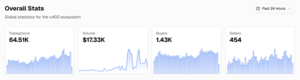
The numbers on x402Scan paint an optimistic picture. Independent analysis suggests x402 currently processes roughly $17,000 in real daily transaction volume, and approximately half of that may reflect facilitator testing and infrastructure validation rather than genuine commercial activity.
For context, KPMG’s independent analysis of the broader x402 ecosystem recorded 161.32 million cumulative transactions and $43.57 million in settled volume by February 2026, with 417,000 buyers and 83,000 sellers active across the network. The protocol moved from infrastructure testing to measurable transactional scale in months, not the years prior payment protocol adoptions required. This is not a condemnation of where things stand. Every major settlement standard begins in exactly this territory.

What x402 is good for, today
The most compelling near-term use cases are associated with Pay-per-query API access where a subscription model is too blunt and an API key too cumbersome fits x402 perfectly:
- A research tool that charges $0.01 per paper download
- A news outlet that charges $0.01 per news item instead of a full subscription
- A media outlet that charges %0.50 per video instead of a full subscription
- A weather API that bills per call
- An AI agent that pays for a single stock quote without a monthly contract
- An AI agent that pays for a one-time compute
- A one-time AI model usage
Organizations exposing data feeds, risk models, compliance services, or regulatory reference data via API gain a payment primitive that removes the subscription acquisition barrier entirely, expanding addressable reach to any agent or client capable of a single authenticated HTTP request.
x402 embeds payments into HTTP and solves a real problem. It uses a long-dormant 402 status code and is practically useful for machine-to-machine commerce. The coalition backing it is unusually credible. Adoption is in progress and we are in the middle of it.

Debashis Bhattacharyya
Debashis Bhattacharyya has over 18 years of experience planning and delivering technology solutions, specializing in Cloud, API, DevSecOps, and Payment Application Modernization. He has been instrumental in Opus’ transformational DevOps initiative with FIS, which won the prestigious DevOps Dozen Award for ‘Best DevOps Industry Implementation’ in 2022.
About us
Opus is a trusted engineering partner to payment providers, banks and fintechs navigating change in a real-time, digital-first world.
Our promise is simple: Business Value Acceleration. Realization. Maximization.
We deliver on this promise through the Opus trifecta-a domain-native engineering skillset, a value-creation mindset, and an Al augmented toolset that drives business agility.
From MVP (Minimum Viable Product) to MPT (Maximum Possible Transformation), Opus turns engineering into business advantage.